Breaking Down Walls Of Text
Walls of text are a very common problem in many video games and among many writers and designers. I figured it’s time to address it.
Walls of text are a very common problem in many video games and among many writers and designers. I figured it’s time to address it.
I’m going to use Textwall instead of Wall of Text. Sounds different.
Better ring to it.
A more precise vibe.
Wall of text almost sounds cool and Textwall is so swift it’s dismissive. Which it should be, as we don’t treat a book as a bunch of textwalls. This term is video game-specific.
This is the core of an issue for me. Different media call for different engagement. I see this problem with writers. As in literature, articles, essays, and academia kind of writers. There are certain rules there too: you rarely see paragraphs taking multiple pages. Unless…
I see this problem with avid readers too. Well, not only avid. Reading is kinda a skill, isn’t it? Reading non-fiction or academic works takes effort. If it was written in German and then translated — oh boy that’s a workout. That’s a project. Dense lit almost requires tools.
I have a long-running project to read Ulysses. I know I’m pretentious, but if you check my games you’ll see a billion references soooo
Anyway, it’s a project because I can’t just read it as I would do with Sedaris, Martin, Ellison, or any other book. I need a dictionary, the Internet, and a notepad. I want to appreciate the poetry and I want to know what’s the reference doing here. I know that many people read textbooks and non-fiction this way and they are way better and it doesn’t take them 5 years to read three chapters. It’s a skill. It’s a rare one.
Not because the world is illiterate but because reading for fun doesn’t make you parse the text.
Now, there are plenty of reasons to care for textwalls in video games. Mainly accessibility. ADHD and Dyslexia are not compatible with textwalls at all. However, I’m on ADHD meds and I still won’t read a textwall but will happily read a book. If your reasoning to avoid textwalls is JUST accessibility, you missed some steps.
Everything above is a textwall. If I see it in a video game, I’m skipping it.
Let’s treat the cause and not the symptom.
In video games, you don’t read. You parse.
If it helps, compare fiction and something academic. The academic text needs to be dissected. You don’t read it for poetry, word choice, or drama. You’re looking for stuff to quote, interesting ideas, and solutions to issues. You PARSE.
Doesn’t mean that academic text is devoid of art, it’s just not the primary reason for its existence.
You can also compare fiction and a curator’s description of an artwork. The latter is to the former what textwalls are for video games. That text is usually incomprehensible.
Treat text as a tool to guide the player and less like prose. The player sees the text and starts parsing it. You control how they do it. When the player (who wants to touch stuff, interact with stuff, and so on) sees a lot of text arranged in big paragraphs, they get a bit overwhelmed. It takes effort (not a big one, but still) to parse the text. See foreshadows, see potential clues, potential puzzles, targets, etc. It’s not just an act of reading in video games.
What if you skip something important if you miss a clue?
Gotta parse the text.
What if you miss a clue on how to defeat a boss?
Gotta parse the text.
What if there is a hint in the text?
Gotta parse the text.
What if there is a clue about a secret in the text?
Gotta parse the text.
GOTTA PARSE THE TEXT
GOTTA PARSE THE TEXT
And I’m not even talking about text-heavy games.
The normal guide for dealing with textwalls is to go multi-modal and cut the text. The former might not be possible (text game), the latter might be hard for you. Plus the problem isn’t that you have hidden information in textwalls.
The problem to solve is minimizing the parsing time, not writing less.
So here are some tricks and solutions for you.
Highlight important shit.
You need the player to get A B and C from the wall of text. Change the font, the color, or go full caps on A, B, and C.
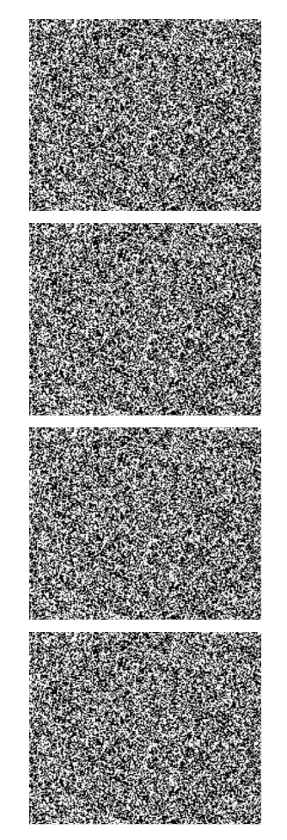
I don’t mean italics. ITALICS DO FUCK ALL IN VIDEO GAMES. Every time somebody is requesting italics, or suggesting italics, or stands by italics, I’m really confused. Here’s how a textwall looks:

If I change the angle of some letters, it looks the same. Do you think I did just that in the image above?
But you see the darker spots, don’t you? You’ll notice red too.

Now I have a textwall that I can start parsing. I see A, B. I SEE C VERY CLEARLY. Even D if I pay enough attention. Is there E there by any chance? That would be a treat! Wait! I found F!
But what is the meaning of A, B, and C? Oh no, I still have to parse sentences, but I crave dopamine from the next level!
I can’t waste microseconds!
YOU TORTURE ME!
DISCLAIMER: I need to specify that I’m talking from left-to-right, letter alphabet perspective and Germanic/Slavic language POV. It’s important for the next parts:
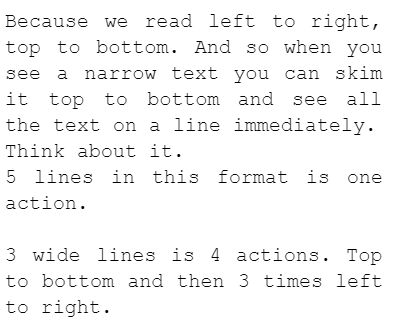
A four-word sentence is good.
You parse it instantly. Literally. You see the sentence and you get it. You don’t see words. You don’t need to even READ it. Longer sentences require parsing. Micro-seconds compound and now I need 10 seconds to deal with a paragraph. Just give me my dopamine already!
Squares are good.
I reckon that one of the reasons dialogue in screenplays is arranged narrowly is to make it easier to parse by money people.
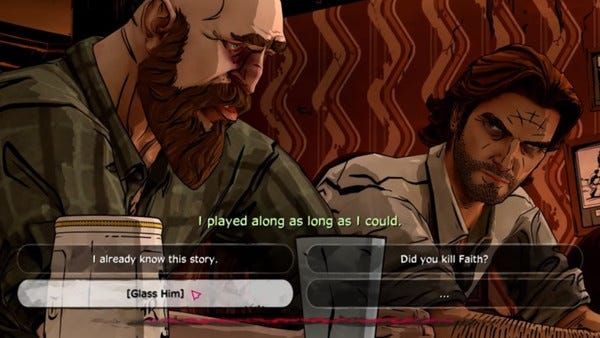
Break the textwalls with interactivity.
Single choice spaces or roleplaying choice spaces work well. They don’t need to add logic or mean anything mechanically, their job is to break text into parcels.
Don’t you agree?
Using choice spaces and making players react to text also helps making sure that they do engage with the text. Information gets tied to an action. Even if it doesn’t mean a lot.
Would you like to know more?
There is a choice space lesson somewhere here. The feeder also helps focus. Information can be offloaded into option texts themselves. But that’s going multi-modal again.
In conclusion:
Don’t think of it as dumbing down and pre-chewing your writing.
That’s game design talk. Players are smart. Players with high medium literacy just found an efficient way to interact with the medium. Game design reinforces it. If a player isn’t very familiar with the medium, they don’t have issues with textwalls. They haven’t been corrupted yet.
The souls-like narrative isn’t that different from a textwall. It’s obtuse, incomplete, stuff is hidden, and it makes no sense unless you know how to look at it. This is a narrative mechanic. So are textwalls.
When you write a textwall, think about the players who were hurt and corrupted by the dopamine delivery machines our industry produced. Gotta do some physical therapy. Gotta feed them with a bigger spoon. Gotta give them some meds.
Players are smart. Help them remember that.