Non-linearity vs Interactivity
Interactive and Linear are different things!
Interactive and Linear are different things!
Here is a framework for you.
Interactivity is the number of ways a player can reach the end.
Linearity is how many ends there are.
Simple right? Spread the word.
I came to this distinction when I was talking to one of my producers about Deus Ex: Human Revolution’s ending. You just choose what happens. To my producer, it felt like a stab in the back for a game that’s so nonlinear. But it was a big decision! It meant stuff.
Same with Mass Effect III’s famous ending controversy. Again, though, the decision is big and important. Doesn’t it fit well that Sheppard is put in front of a massive decision?
Don’t think about the final choice as just that. Every choice you’ve made has affected the world, your PC, and you directly. Are you dismissing all of it?
The ways we were talking about linearity, interactivity, and even agency were flawed. Our language didn’t have appropriate ways to discuss and dissect these subjects. Well, here it is.
Deus Ex: Human Revolution is highly interactive and non-linear. However, the pacing of interactivity wasn’t maintained until the end.
Mass Effect III is interactive and still non-linear. However, it dips in interactivity compared to previous installments which sours the feeling, and the target of said interactivity in the end isn’t as personal. I know Mordin, I don’t know everybody else. Does it include Garrus? I don’t care about Garrus.
Linearity to me is less important than interactivity so we will begin here.
Linearity is absolute. How many endings are there? More than one — you’re non-linear.
Baseline — add a final choice.
Bonus points if a player’s actions affect which one you get.
Extra points if you lock some of the endings depending on the player’s actions.
Another 10 points if you have secret endings.
A fail state is not an ending. Fail state implies you HAVE to replay. An ending is final. You should be able to leave the game after getting it even if it’s a bummer.
Couple of examples that are weirder and will challenge your perception of linearity:
Cave Story+ has three endings, however, are they actually endings? They feel like:
- Chickening out of the final fight.
- Missing out on the actual final piece of the game.
- Completing the game.
I’d say it’s two fail states and an actual finale.
Nier: Automata has a ton of endings, but like how many of them are actually endings to the playthrough? Just because you saw credits, doesn’t mean the playthrough is over. So how many endings does it have?
Obviously, eating a weird fish and dying doesn’t count. It’s a fail state.
Now to the fun stuff.
Interactivity
Not to be confused with agency.
Agency is how much of a direct effect the player can have on the playthrough. Interactivity doesn’t care.
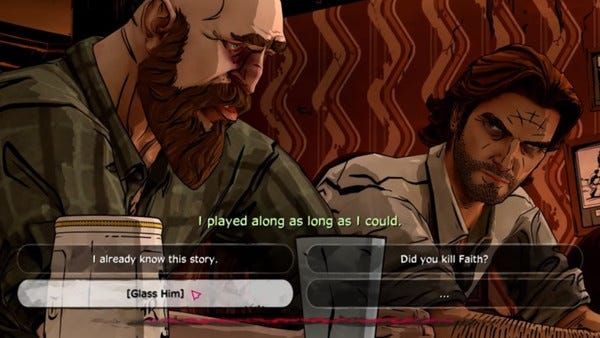
Do you get three dialogue choices in a conversation? It’s interactive. Doesn’t matter if they hit the same line afterward.
Do you get a selection of weapons and the game doesn’t force you to use a specific one? It’s interactive.
Can you go to the mountain you see in the distance? It also adds to interactivity. The keyword is adds.
Interactivity is not absolute. It can be high or low. You can pace it. You can play around with it. You can put it in different places. Interactivity is a good tool. Interactivity is useful.
Absolute interactivity is only possible in LARP and Tabletop spaces, not even all of them. The player in video games can only do what the game allows them.
High interactivity is great but hard to maintain. It’s a lot of work. A LOT. There is a reason why it took 12+ people in the narrative department to do it.
So don’t chase the highest interactivity possible. Embrace the fact that you need to work with it.
If you suddenly see a choice space with only one option, shit. That’s a heavy moment! Opening up dialogue interactivity can mimic how the player gets more freedom.
Westerado: Double Barrell gives you the option to pull out a gun in every conversation. It adds so much to the interactivity.
Dialogue choices with no effect on the playthrough (at least immediate) are great. They allow you to role-play, the player gets to be seen. Also, some people don’t listen to what you’re saying. Some people will keep saying the same thing again and again.
The application of interactivity as a metric to different areas, scenes, and mechanics allows us to use it. It lets you view the games more consciously. Open-world games can be non-interactive everywhere except just the open-world part. You can do anything you want but the main story is non-interactive and linear. With this approach to interactivity, open-world games can’t hide behind kilometers-wide maps anymore.
Interactivity is also a strong tool if you’re working with more artistic games. Taking it away, gradually or suddenly, is a heavy hit. You’re spiraling toward the inevitable.
Like with many design decisions you need to make them consciously. You decide how much, when to dial it down, and when to ramp it up. Don’t let it run away from you.