On Choice Spaces
This is an absolutely essential and fundamental concept.
(This is an absolutely essential and fundamental concept.)
I wanted to make this thing public for a long long time.
Ever heard of beats? The smallest element of movie scripts? Or actions? Or sentences? Or movements? Interactive story-telling has one too. I learned about it by accident while interviewing Emily Grace Buck and I was shocked it’s not public knowledge.
Choice Space is the smallest element of narrative design, any game or playthrough can be broken down into a string of choice spaces. Even a railroaded corridor shooter.
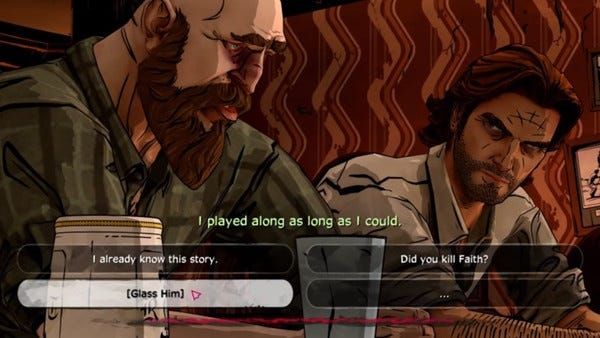
As this term comes from the Telltale environment it’s fitting to use a screenshot from their game to illustrate:
Here, and in text-heavy games in general, it’s obvious where the choice space is, but it doesn’t end with text. I’m getting ahead of myself.
Here is the anatomy of a choice space:
A player gets to the choice point. (Setup)
A player is prompted to choose. (Feeder)
A player sees options they may choose. (Presentation)
A player picks the option. (Options)
A player sees the result of their choice. (Consequences)
The worst-case scenario with choices is that the player will pick at random. A random choice means nothing and the consequence of said choice is meh — they picked at random. Why should they care?
Choice Spaces help solve it by providing a framework through which to examine every choice and decision.
We’re not getting through them in order.
Options
I do not mean how they’re written. I mean how many are there and what are they?
The amount of options doesn’t need to be important but you should think about it!
It’s 1 to infinity. Whatever fits your game or your narrative. That said though binary choices feel more important, triple choices are associated with role-playing, and four choices fit a d-pad well.
Don’t forget to lock out some choices if you’re going with 4 and above. Too many choices lead to decision paralysis and the player will pick at random or the pacing is forever ruined.
Presentation
This is a huge ass topic so broad strokes only.
Are you using text? Are you numbering your choices? Are you using just a verb or a mood as the option text or a full line? Is it just icons instead of text? How do they appear? What happens on hover? Are you showing the options you can’t pick?
This is where UX part of narrative design comes in. The presentation needs to be understood perfectly and quickly enough to make an informed decision.
Consequences
That’s a simple one. The short-term consequence is something that happens directly after. A line, a notification, a small word change. Something that lets the player know the decision was made. It can also be the player character’s line if you didn’t show it fully before.
The important thing is to honor the decision. The problem is you don’t know what exactly the player decided if you didn’t present the choice completely, perfectly, and transparently. You totally shouldn’t, it’s not always possible. However, if the player makes a choice and sees that game assumed a different meaning to the choice, the player will resent you.
The long-term consequence can happen hours later. Or not at all. You can check my post on Interactivity and Linearity (paywalled) to see more on that.
Feeder
This is a line or an image that shows what your decision is referring to. For starters, it’s a good way to telegraph the consequences and inform the player of the stakes. More importantly, this is a way to orient the player about the choice space.
Or re-orient, if say an autosave happens exactly before we choose and the player instead decides to go to sleep and return later. Gotta remind people about what’s going on.
Setup, PC
PC as in player character. You can treat it as a sum total of all experiences the PC has experienced leading to the decision. This is for you to track. The player isn’t necessarily aware of it all the time.
But depending on the choices that happened before, character met, wins and fails, we might present different decisions, lock some of them, and highlight some of them. Maybe because of the setup the decision will simply never happen.
Setup, Player
This is what your player experienced so far. IN LIFE.
I mean it. Where are they from? What’s their age? How aware are they of the genre and medium? Have they looked at the Wiki? Are they playing alone? Are you in control of what they’re experiencing?
This is again a big topic that warrants its own space. At the moment of writing this, I haven’t yet published it. For the sake of an example, I will never pick a faith or religion-related option.
Away from Text
Choice Spaces exist whether they look like a choice or not. Syd Meier said: “A game is a series of interesting choices.” They all are choice spaces.
On the subject of civ-likes. You’re playing Age of Wonders 4 and you’re making your faction’s culture. That’s a choice space.
Setup, PC — doesn’t exist yet if your pantheon is empty.
Setup, Player — in full play! We kinda assume what they mean since it’s a fantasy game that doesn’t sway away from the mainstream.
Options — well there are six and they are quite major decisions.
Presentation — they are showing parameters affected, an icon, and a name. And it makes Feudal look “good” in a karmic sense, why?! And what exactly is Shadow? Am I sneaky, evil, or troglodyte?
Consequences, Short-Term — it affects cosmetic armor choices and maybe starting units. Quite important.
Consequences, Long-Term — this is part of your starting conditions it will affect this playthrough.
See, fits perfectly. You can also look the same way at skill trees in RPGs, shops in rogue-likes, and leveling up in souls-like. Even exploration in platformers or, again, in souls-likes can be split into a series of choice spaces.
And Now Gun
It gets further if you want. Take a shooter.
Setup, PC — your convoy of refugees is ambushed! You’re the only one who can save them!
Feeder — enemies shooting at you from all directions! Refugees are screaming!
Options — help escape, kill enemies (Which one first? With what gun?)
Consequences — win or lose, life or death.
You might look at this and go “You’re overthinking it!”
I will counter with:
Setup, Player — I hate escort missions!